Build-to-rent specialist Bluecastle Capital: ‘I’d put 100% of my wealth into urban flats’




Bluecastle Capital is developing build-to-rent schemes across the UK, including Wales’ tallest tower. Founder and chief executive Ed Williams tells Zainab Hussain why he is betting big on high-rise urban flats.
Bluecastle Capital is Ed Williams’ third business and his first in the living market. It is a developer, investor and asset manager focusing on multifamily schemes and high-rise urban flats, launched in 2015.
We meet Mr Williams, the company’s founder and chief executive, at Bluecastle’s sleek office in south-west London to learn more about why he is focusing on high-rise urban flats, at a time when the majority of build-to-rent (BTR) investment is now turning towards houses.
When we sit down in a meeting room to discuss his business, Mr Williams smiles and says passionately: “You’ve got institutional housing in the UK – for my money it’s absolutely a standout. I can’t think of a better risk-adjusted return. If somebody said to me, ‘you’ve got to put 100% of your wealth into one asset class’, I would say, ‘fine, I will put it into [multifamily]’.”
Mr Williams’ comment runs counter to a big BTR trend of recent years: investment moving from urban flats to suburban houses. Some developers have told Inside Housing Living that multifamily projects may not be viable anymore because of delays at the Building Safety Regulator (BSR) and rising construction costs.
Earlier this year, Real Estate:UK (formally the British Property Federation) and consultancy Savills found that the number of BTR homes under construction has fallen 17% year on year, and in London by 29%. The war in Iran could exacerbate matters – with developers warning that it could push up construction and energy costs even further.
So what sets Bluecastle apart?
“We’re privately owned, I don’t have any shareholders,” Mr Williams tells Inside Housing Living. “There’s nobody above me saying what I have to do, so we can afford to be very different to others.”
That’ll be a theme throughout our conversation. As Inside Housing Living unpicks Mr Williams’ vision for Bluecastle, his thoughts on a number of topics – from the Building Safety Regulator, to rural development, to co-living – may run counter to those of many in the sector.
But first, how is Bluecastle backed financially, and why is it focusing on high-rise flats?
How Bluecastle operates
There are some principles governing how Bluecastle goes about developing its schemes. For instance, the developer only builds its schemes from the ground up instead of acquiring existing buildings.
“I did decide when I got involved in real estate that I wanted to be in the development end because that’s where most of the value creation happens,” Mr Williams says. “If you’re involved in the dry end, you’re kind of squeezing the last drops of juice out of the lemon.”
He adds: “[Development is] where you design things, it’s where you choose the land, [and] it’s where you can get the locations right. It’s just all of the opportunity.”
Another principle is Bluecastle’s no-debt policy.
“The first reason is, first and foremost, our responsibility is to our investors because we raise their body money,” Mr Williams says. “So, we raise capital to acquire our sites and develop them, and we’re raising capital to build and own the site. And I may be old-fashioned, maybe a little bit extreme in this view, but I take the view that the minute you start using debt, you have lost control because you’ve given it to a lender. If you lose control at the development stage, that’s quite risky because you very rarely control all the risks and the timing.”
He adds: “By definition, your risk-adjusted return is different with debt. And in my own opinion… it gets worse.”
Bluecastle’s funding model is made up of two funds at two stages. The first fund is a capital fund that has already raised £70m deployed into the five sites, and will continue to grow as the developer acquires more sites.
The second fund, at the second stage when the capital is forward-funded, is a long-term institutional capital fund that houses that capital. The types of investors in that fund include pension funds, insurance companies, sovereign wealth funds and family offices.
At the first fund, Bluecastle strays away from “institutional money” and prefers “entrepreneurial-type people” such as family offices and investors with very high net worths, because they are “willing to take planning risk”.
Another one of Bluecastle’s principles is that it acquires its development sites directly from sellers.
We’re in the high-risk building business. Every single one of our buildings will be high-risk.
“We don’t acquire sites through agents… therefore we get very good value,” Mr Williams explains. “So, if you’re not leveraging something that is worth what you paid for it, you’re kind of on safe territory.”
When Bluecastle is buying land at or below market value, no debt finance is employed to leverage it. This is, Mr Williams says, a safe position to be in because the money is unlikely to be lost even if the site is not developed.
Mr Williams argues that a scheme should have at least 200 homes to make it operationally viable. And while other developers have been put off by the introduction of the BSR, which can mean added layers of scrutiny and some delays to construction, Mr Williams is not.
“We’re in the high-risk building business,” Mr Williams says, referring to the Building Safety Act 2022 definition of a scheme higher than 18 metres or seven storeys.
“Every single one of our buildings will be high-risk,” he continues. “Two of them are going to be 50 storeys, one of them is going to be well over 40, and the other two are over 20.”
Building safety and viability
“We see [the building safety requirements] as an opportunity,” Mr Williams says. He has spent nearly four decades of his career in financial services, working in structured investments at Merrill Lynch, and as chief executive of specialist real estate asset manager Pinder Fry & Benjamin.
“[I] have been regulated for 38 years in a much stricter environment than construction. Construction is only now being regulated properly, that’s what the Building Safety Act is all about… and I think that’s a really good thing.”

Others in the sector are struggling with BSR rejections in two main ways, he argues. The first way is that some developers are still getting their heads around structuring their business to cope with the new requirements, and around how to avoid unnecessary delays through incomplete submissions or incomplete evidence trails during construction.
The second way is that once developers do reach completion, they haven’t got an evidence trail of compliance during the construction phase, including videos and pictures of what they are required to do, so they are having to start again and have their buildings inspected.
To achieve viability, Mr Williams says four requirements have to be ticked off: yield, rents, build cost and land. A positive development value, or development return, should also be achieved.
“We have an in-house scoring model and viability model and it takes data from lots of places,” Mr Williams explains. “There’s 350 local authorities in Great Britain excluding Northern Ireland, and only 83 of them are viable and have enough population to support rental.”
Construction is only now being regulated properly, that’s what the Building Safety Act is all about… and I think that’s a really good thing.
The 83 locations, he adds, can be further reduced to 20 when considering factors such as: depth of demand, rental growth, capacity and headroom for rental regeneration, jobs, and student retention of the local university (which is an important indicator of economic growth).
“When people are talking about viability, often they’re talking about the other 330 [local authorities],” Mr Williams says.
“Why? Because they’re being presented a scheme by a developer that’s got his numbers wrong, in the wrong place, and it doesn’t work.”
Why multifamily housing?
Currently, Bluecastle has five multifamily projects in the pipeline. It does not have any operational homes yet.
This is because Bluecastle wants to develop its own bespoke designed schemes, taking them through construction to the operational phase. Bluecastle has spent the past four years identifying, acquiring and designing those sites that it says are optimally located and designed for the long-term fund.
The developer’s first scheme is a 69-metre tower made up of 225 homes in Stevenage, Hertfordshire. The development site was acquired in 2023 and the scheme received planning permission in February 2025. Bluecastle also acquired a consented multifamily scheme in Sheffield in 2023, which will have 409 homes.
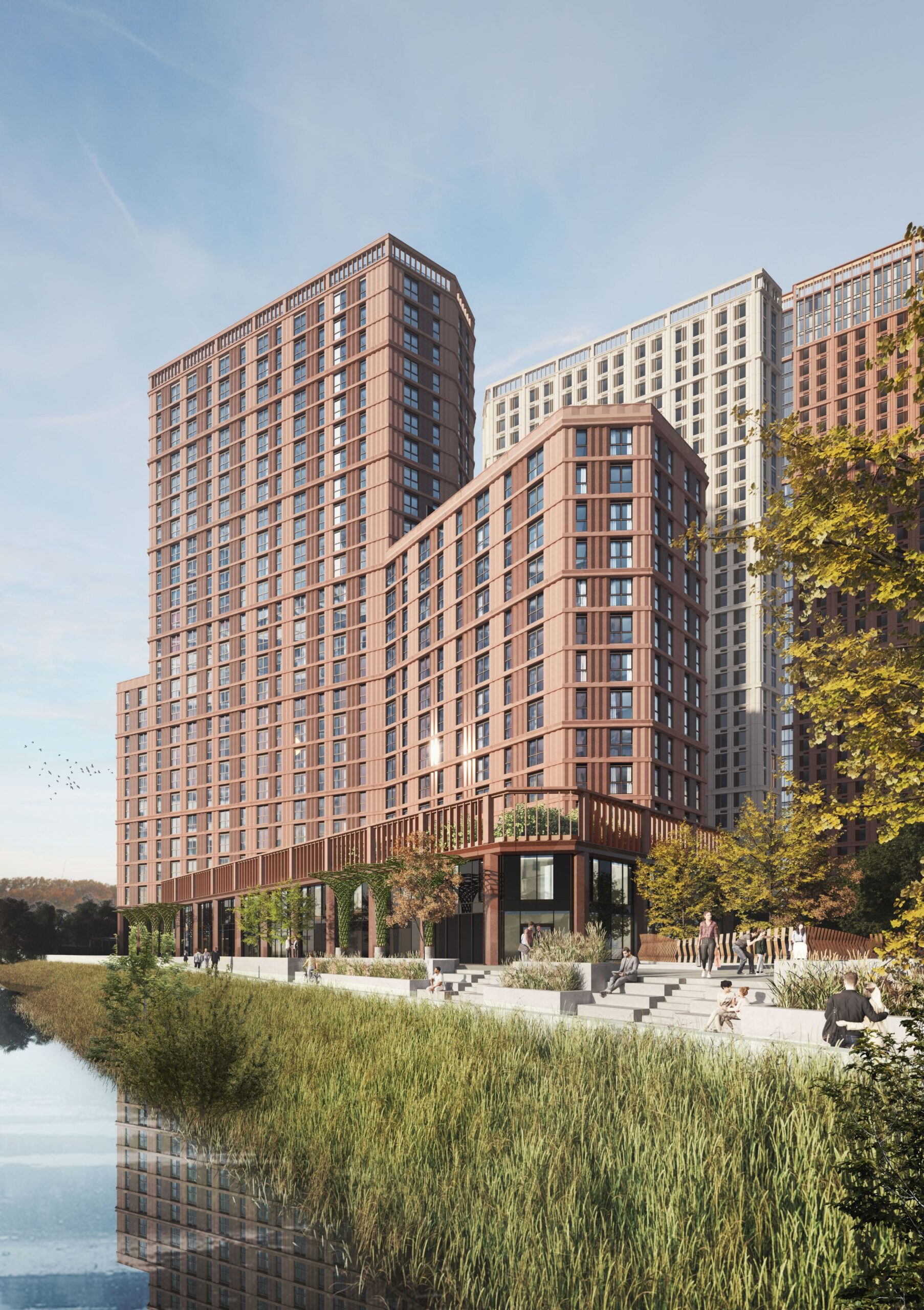
In 2024, Bluecastle acquired a site in Cardiff where it plans to develop a 50-storey, 528-home multifamily block, set to be the tallest tower in Wales. The scheme was approved in March. It also has plans for schemes in Birmingham and Leeds.
Why did Mr Williams decide to get involved in the living sector in the first place?
“What interests me about real estate is that it kind of represents every sector of the economy in many respects, because you can have one sector that’s booming and another sector that’s done really badly,” Mr Williams explains.
“And that kind of creates a really interesting opportunity within real estate, within the asset class, particularly if you’re agnostic.”
When Bluecastle was launched, Mr Williams was focused on developing build-to-sell homes. Bluecastle is Mr Williams’ second property business, preceded by Pinder Fry & Benjamin, which he exited in 2014 after it was absorbed into a third-party asset management business. At Bluecastle, Mr Williams made the switch to private rent after the Covid-19 pandemic.
“I was looking at [the living sector] through the build-to-sell prism and that looked pretty good at the time because it was still very much the Cameron sort of philosophy, of subsidising first-time buyers and housing and the Help to Buy scheme,” Mr Williams explains.
I think co-living is designed by a spreadsheet.
David Cameron’s government introduced the Help to Buy scheme in 2013 and pledged the Starter Homes initiative in 2015. The policies were intended to help young people get on the property ladder by lowering deposit hurdles and providing discounted properties. Since then, the Help to Buy scheme has been scrapped, and the Starter Homes initiative never materialised.
“The interest rates were still very low, so we got involved with that sector. But it was through that that I really discovered BTR.”
He adds: “For me, it was just really simple: we weren’t building enough homes [and] the population was growing. Institutional residential BTR has a fundamental basic need attached to it, unlike some other real estate classes.”
Beyond multifamily
Currently in the UK, BTR can include multifamily schemes, suburban homes or single-family schemes, and more recently co-living schemes. But to Mr Williams, these tenures are different.
On suburban homes, Mr Williams says Bluecastle “definitely would” enter the market. Single-family projects have “very different characteristics” to flat investments, he says.
“I think one of the challenges is logistics, because the problem you have with single-family is, by definition, it tends to involve more land because they’re houses.”
“So, you’re talking acres and acres to have a meaningful scheme. That means outside of cities, it means low population density typically. Therefore, you wouldn’t want to develop too many at a time in a particular location, because you’re going to have absorption issues and you’re going to saturate the location.”
“We have decided, for now, to be in the multifamily business, and that has very different characteristics operationally and in terms of land acquisition, and in terms of capital allocation and timeframes and returns,” Mr Williams adds.
What about co-living? “I think co-living is designed by a spreadsheet,” Mr Williams laughs. “I think people are struggling with a BTR scheme and they say, ‘What if we make the apartments really small, but we give similar amenity to a BTR scheme? Wow, these numbers look amazing’.
“I think the result when they’re built will be more transient residents, because not everyone wants to live in a very small apartment for very long.”
He adds: “The numbers could get very challenging in terms of the levels of rent they try to achieve once we reach a more mature BTR market, and there’s competition at that level.”
Mr Williams envisions highly amenitised prime locations being bought up over the next few years, and giving way to suburban or secondary sites.
He also thinks there is a place for zero-amenity schemes, particularly in cases where people can use amenities in nearby amenitised schemes for an additional charge.
“I think things like co-living may come under pressure,” he says. “A lot of the BTR schemes that have been developed today – not all of them, some of them are really good – but some of them have been designed a little bit with student-style amenity in mind, [and] may suffer as the market matures.”
Geopolitical pressures
With rising costs looming as a result of higher interest rates and more recently the war in Iran, how is Bluecastle responding as it breaks ground on its schemes?
“We’re a bit concerned about construction costs and what might happen there, and supply chains,” he admits.
But Mr Williams remains bullish, stressing that Bluecastle’s fundamental philosophy is to be a long-term business: “The great thing about this is that it’s much longer term, so it should fly above the turbulence.”
Ultimately, it comes down to supply.
“The population is growing,” he says. “If you look at where BTR is going… if you look at where the housing supply solution is likely to come from, I can’t see any other solution than rental being a major part of it.”